Friday, March 31, 2006

Hunting The Bluebird

Just how happy are you? It's a question that's hard to answer, and most people's responses could vary from minute to minute, situation to situation. It's also one that has been weighing on my mind of late, as I try to conquer the chronic depression and stress that I've struggled with for much of my life. I imagine that most of you could empathize with the feeling that it's always something: if I was happy with my career, my living situation was a mess. If I rectified that, it was finances that troubled me. Once I got that under control, my love life was torrid. Working that out circled back to career dissatisfaction, or health problems, and so on. How does one get prepare for the future and yet live in the moment? When do we say, "I am content, I have enough"? Apparently I'm not the only one asking these questions, because just in the last few days I've been noticing riffs on the nature of happiness popping up all over. Let's take a few days ago, when I went back to read a section of the New Yorker I'd previously missed. In the book review section, John Lanchester analyzed three recently released books on the pursuit of happiness. According to Jonathan Haidt's "The Happiness Hypothesis", how happy one is may largely be based on genetics. This is because, evolutionarily speaking, it is more likely that those who are cautious and avoid threatening situations will survive. So, our ancestors who worried enough about their survival to make it passed down that tendency to worry to us. In addition,
"bad is stronger than good" is an important principle of design by evolution. "Responses to threats and unpleasantness are faster, stronger, and harder to inhibit than responses to opportunities and pleasures." This is a matter of how our brains are wired: most sense data pass through the amygdala, which helps control our fight-or-flight response, before being processed by other parts of our cerebral cortex.

Meanwhile, Darrin McMahon, a historian at Florida State University, argues in his book "Happiness: A History" that

the idea of happiness is not a human universal that applies across all times and all cultures but a concept that has demonstrably changed over the years. When your attention is fully concentrated on questions of survival, you don't have the time or the inclination even to formulate the idea of happiness. You have to begin to feel that you have some control over your circumstances before youbegin to ask yourself questions about your own state of mind.

So, already we've established that people may be more or less hard-wired to be anxious. This may be something of a comfort for those like me who have resorted to all kinds of meditations and medications to allay chronic stress, but at the same time can make the struggle seem somewhat Sisyphean. After all, how much nature can we fight with nurture?

At the same time, it's not surprising to find that the very concept of happiness has evolved over time. For early humans (and sadly, still for many today), just having a full belly could be cause for celebration. That is why so many holidays center around feasts, even when in modern times a Taco Bell or Hot Pocket is within easy reach for most North Americans at any given moment. However, as we gain more luxuries and tools, it doesn't necessarily make us happier. Why is this? Lanchester writes:

The simplest kind of unhappiness is that caused by poverty. People living in poverty become happier if they become richer-but the effect of increased wealth cuts off at a surprisingly low figure. The British economist Richard Layard, in his stimulating book "Happiness: Lessons from a New Science," puts that figure at fifteen thousand dollars, and leaves little doubt that being richer does not make people happier. Americans are about twice as rich as they were in the nineteen-seventies but report not being any happier; the Japanese are six times as rich as they were in 1950 and aren't any happier, either. Looking at the data from all over the world, it is clear that, instead of getting happier as they become better off, people get stuck on a "hedonic treadmill": their expectations rise at the same pace as their incomes, and the happiness they seek remains constantly just out of reach.

Speaking of treadmills, I was running on one yesterday morning as I mulled these issues over during my workout. Why have I been so pessimistic over time and why do I continue to do and experience this even though it clearly leads to aborting experiences that could cause me happiness, perhaps disproving my negative assumptions? Is it because I am somehow hard-wired with a given level of happiness that is almost impossible to transcend, as Haidt maintains? Or is it because my definition of happiness is always changing, i.e. the more I have the more I want, as Layard and McMahon hypothesize? As often happens, I idly checked out one of the television monitors above the exercise machines at my gym. In place of the usual morning news programs or cartoons, however, there was a religious show.

Joyce Meyer, who apparently runs a large (and no doubt highly profitable) Christian ministry, was on stage exhorting church members to let go of anger against those who had wronged them in the past and put out love instead in order to feel happy. Many folks in the audience were clearly moved as she described how she had overcome the devastation and anger resulting from childhood abuse through spreading joy in Jesus' name.

Now, while I watched all this I was skeptical, as I usually am when it comes to God Talk. After all, most televangelists also happen to have admirers galore, mansions and various other riches to keep them happy, which makes speaking for God, whatever they think that means, a rather fulfilling affair for them. But, it did bring to mind something that many religions and philosophies do emphasize as the path to happiness: to stop worrying about things and let some greater being or concept - be it Jesus, nature, fate or mere time - take over your emotional burdens. I may not believe, like Meyer purports to, that all of my negative thoughts are caused by Satan, but I've studied enough of both Buddhist practices and basic psychology to gather that a mind fully in the present and engaged tends to be content, whereas focusing on the future or past can breed tension.

And there's the crux, because our society is not geared toward that. Except in rare cases, the modern pursuit of happiness is sold to us not just as general well-being and safety, but as acquisition. How can you truly feel safe if you don't have a huge SUV and a house you own? How can you feel worthwhile when you are not protecting your loved ones with the proper insurance and investment plans? And while you're doing all that, you've got to reward yourself, don't you? After all, how can you be a respectable part of society if you don't keep up with what the Joneses own?

This is addressed again in this week's New Yorker by John Cassidy. In his article, "Relatively Deprived", Cassidy notes that, since the mid-20th century, methods for calculating the poverty level in the United States have been based on comparing a minimum required income to provide food multiplied by three, assuming that the cost of food took up one-third of the typical family's budget, on average. However,

In 1995, a panel of experts assembled by the National Academy of Science concluded that the Census Bureau measure "no longer provides an accurate picture of the differences in the extent of economic poverty among population groups or geographic areas of the country, nor an accurate picture of trends over time." The panel recommended that the poverty line be revised to reflect taxes, benefits, childcare, medical costs, and regional differences in prices. Statisticians at the Census Bureau have experimented with measures that incorporate some of these variables, but none of the changes have been officially adopted.

It comes as no surprise that no one can agree on the variables. For one thing, there's just too many of them. For another, the issue is highly political: conservatives would like the numbers cooked so that they indicate less poor folks exist, whereas liberals fear that moving away from basic, subsistence figures will result in priorities becoming confused and some poor populations missing out. But, perhaps most important of all, recognizing that poverty is dependant on multiple variables indicates that it is not so much dependant on actual goods as relative wealth. For example,

Although many poor families own appliances once associated with rich households, such as color televisions and dishwashers, they live in a society in which many families also possess DVD players, cell phones, desktop computers, broadband Internet connections, powerful game consoles, S.U.V.s, health-club memberships, and vacation homes. Without access to these goods, children from poor families may lack skills-such as how to surf the Web for help-wanted ads-that could enhance their prospects in the job market. In other words, relative deprivation may limit a person's capacity for social achievement."

Not only is it a handicap in terms of social achievement, however, but in social rank and yes, happiness. Recent studies have shown that workers' reported levels of job satisfaction had less to do with their salaries than with how their salaries compared with those of co-workers. It seems that humans, like other animals, tend to compare ourselves to others in our community and rank ourselves accordingly. This is why a simple farmer in a small Third-World village may feel more relatively wealthy and happy than a middle manager in a North American corporation. The farmer compares himself to the people around him, who are working hard just to survive, and appreciates it when he gains luxuries or has a good crop. The middle manager wants to be a high-level manager and buy new car, even though she usually doesn't worry about having enough to eat.

So, what's it all about? Clearly, how we perceive and rank our happiness is complex. One may have to factor in one's hereditary threshold of happiness alongside the goods we own, weigh our spiritual beliefs against the standards of our community, and understand both our tendency to socially rank ourselves and our historical definitions of just what happiness is. It's enough to make feeling good feel impossible. Still, it can be done. According to Haidt, "It's better to win the lottery than to break your neck, but not by as much as you'd think. . . . Within a year, lottery winners and paraplegics have both (on average) returned most of the way to their baseline levels of happiness." This is not just because the paraplegics descended from happy folk and the lottery winners had anxious ancestors and rich neighbours, but because of two basic things:

1. Everything is relative, and

2. Happiness does not bear analysis well. As what might be considered a middle-class New Yorker, if I compare myself to the poor, Third World farmer, I'm likely to feel very fortunate, but if I compare myself to a rich Manhattan stock analyst, I feel relatively poor and socially unimportant. This affects my happiness. However, clearly it is how I conduct that very comparison and analysis that undermines my personal happiness. I can - and often do - feel just as unhappy because I am angry that my life is not as straightforward as the farmer, or I'm not appreciating what I do have in comparison. I may be pissed off that how others treat me is based on my wealth compared to the banker, or feel better about myself because I've done alright without the benefits of greater wealth and see myself as morally superior than those who doggedly seek them.

To counter this, I can try to train myself to always compare oneself somewhat favourably. But this involves some sort of trick of the mind, be it through faith, learned habit or sheer force of will. One way or another, it seems, I will have to overcome my patterns of comparison, be they part of my genes or learning, to always look on the bright side. Simple, but not easy. And chances are, at some point, whether through insecurity or objective analysis I'm going to come up short next to someone else.

So, let's say I try not to compare myself to others at all. Lanchester writes:

In the end, the philosophy and the science converge on the fact that thinking about your own happiness does not make it any easier to be happy. A co-founder of positive psychology, Mihaly Csikzentmihalyi, made people carry a pager, and told them that every time it went off they should write down what they were doing and how much they were enjoying it. The idea was to avoid the memory's tendency to focus on peaks and troughs, and to capture the texture of people's lives as they were experiencing them, rather than in retrospect. The study showed that people were most content when they were experiencing what Csikzentmihalyi called "flow"-in Haidt's definition, "the state of total immersion in a task that is challenging yet closely matched to one's abilities." We are at our happiest when we are absorbed in what we are doing; the most useful way of regarding happiness is, to borrow a phrase of Clive James's, as "a by-product of absorption."
Considering this, it would seem that the ultimate key to happiness is to not compare oneself with other people or possibilities by being focused on the present. However, as comparing seems to be animal nature and how we understand who we are in the world, it is nigh on impossible to avoid. As countless seekers, mystics and philosophers have discovered, I may simply try to be engaged in life, but the moment I ask find myself asking if I am happy, I become less so. It takes another type of mind trick or training not to fall into thinking "too much". So, what are we who are generally cynical to do? Find some way to stop thinking about how we feel, or convince ourselves we feel good, somehow? Either path is difficult and requires training and faith. But then, being constantly unhappy requires the same. How else do we see all before us as displeasing or deficient?

Which do you choose?

I Just Got Back From Hell

... because I finally downloaded The Darkness' latest album, "One Way Ticket To Hell...And Back". As the title indicates, The Darkness have a way with a joke, but they also have mad skillz as hair-metal type musicians.
Extremely popular in the UK, the band has somehow not made as bit a hit in the US. I suppose it shouldn't be a huge surprise, since their brand of Queen-meets-Limozeen farce-rock doesn't exactly fit in with the hip hop/pop dominated charts here, nowadays. Not to mention, I think the youth of America probably don't get the in joke and tongue-in-cheek attitude that make The Darkness so awesome. When, in concert, lead singer Justin Hawkins is levitated over the audience in a giant pair of flashing tits, it's clear that it's both mocking and just for the sheer fun of it all. There's a sense of meta riffing-on-Spinal-Tap-riffing-on-Black-Sabbath that is funny and knowing, but at the same time, revels in the stupidity of rock n' roll overkill. The fact is, however, that the band is also enourmously talented - capable of lighting fast guitar riffs and fist-pumping falsetto harmonies - and the combination of the two makes them stand above the crowd.

Having greatly enjoyed their first album, "Permission To Land", I was somewhat worried about their sophomore effort, but it does not disappoint. While arguably less hard-edged and headbanging, "One Way Ticket To Hell...And Back" plays up their homage-to-Queen style even more than before with more vocal layers and keyboards. This is no suprise once you learn that they hired producer Roy Thomas Baker, who cut his teeth on some of Queen's biggest hits, including "Bohemian Rhapsody." It's a great fit, considering the oft-told tale that the brothers Hawkins discovered that Justin could sing during a karaoke rendition of that song, and it pays off with songs like "Is It Just Me?", "Dinner Lady Arms", and, yes, "Knockers" (with its giggle-worthy chorus of "I just love what you've done with your hair!") kicking the jams just as much as almost anything on their debut.

At the same time, the album may be even sillier, including a guitars-as-bagpipes nod to Big Country on "Hazel Eyes" (which along with the chorus "And she said 'hoots, I cannae get back tae me hoos in bonny Scotland'" includes the immortal line "I had never seen a set of eyes more hazelerer") and the most musically dark track on the album, "Bald", which is, indeed, a horrified take on male pattern baldness ("his hair, at an alarming pace, running away from his face").

In short, if you ever enjoyed rocking out to 70s and 80s metal while at the same time recognizing the glam buffoonery the genre encouraged, you can't go wrong with The Darkness.

Now, as an added bonus, here is what is, for numerous reasons, possibly one of the best music videos ever, "I Believe In A Thing Called Love", off of "Permission To Land".

Wednesday, March 29, 2006

3-D or Not 3-D

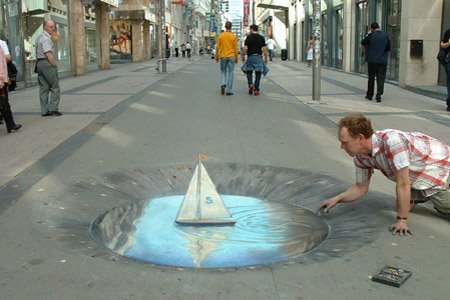
That is the question about this picture:

And the answer is: not. This is actually a sidewalk drawing by the artist seen at right, Julian Beever. Cool, eh?

For more freaky pavement illusions, check out his site.

Tuesday, March 28, 2006

Animals A-Go-Go

I jest loves me some critters, part 8,076...
  • First off, I've added Animal of The Day to my sidebar. A pretty nifty way to learn more about animals I've never seen before. Check out the full site for more.
  • Today I stumbled across Little Turtle Heads Poking Out. No, not just my Read-Eared Sliders' usual feed-me faces, but a nice site on all things cheladonia. If you are a turtle fan like me, you will want to see what the Unlicensed Turtle Wrangler is up to. If you're not, check it out and you may become a fan.
  • The size of this cat is impressive, but I am even more amused by the 80s cop movie-style soundtrack.
  • And finally, I give you the kitten/tribble, or... kibble!

My God, where are its limbs?!

Photo via the inimitable Cute Overload, although it does remind me of Li'l Brudder...

Hello, Mr. President

OK, I may be behind on this one, but I was just thrilled to discover that Jimmy Carter has started a diary on DKos!

Words cannot describe how much I admire this man. I don't think the term "pine" would be strong enough to indicate how I feel - as in, I pine for a new U.S. president with half his character, or I pine for him to be my adoptive grandfather and/or mentor. I am just all a-twitter at the opportunity to read recent posts from him and see how he answers questions.

His first post was, understandably, a plug for his son's senate campaign in Nevada and his current book (both worthy causes), but it looks like he's taken up answering questions now, and may have more comments in the future. Joy!

Welcome to the world of blogging, Mr. President! I can't express enough how thrilling and humbling it is to have you here.


P.S.: Squeee!

Monday, March 27, 2006

Don't Ask

Or, can you tell I'm bored today?

The Kiss of Wha...?

Apparently it is now alright for me to kiss Mrs. Nator anywhere except in the gym. I discovered this suddenly one day recently when I visited her near the cross-country ski machines to tell her I was done with my workout and heading home. Leaning in to plant a peck on her I got the full-on head snap backwards and fart-smell face. I immediately assumed I must be in the proverbial doghouse.

Me: What's the matter? Do I smell bad?
Mrs. D: No, you never smell bad. [Ed. - it's true!]
Me: Are you mad at me or something?
Mrs. D.: No. Just... don't.
Me: Don't what?
Mrs. D: Don't kiss me. No PDA here.
Me: ...uh, why?
Mrs. D: Because I feel it's inappropriate and kinda gross.
Me: <pause of confusion> Since when?

Here I feel obligated to point out that not only had I given her kisses at the gym several times before quite recently - all very polite and tongue-free, mind you - but we actually have had arguments in the past because I felt that she was way more into PDA than I felt comfortable sharing. In fact, I'd say that one of the first big disagreements we had in our relationship revolved around this, as on our second or possibly first date (that's another disagreement we may never resolve) she got three sheets to the wind and repeatedly groped me at a party full of co-workers. She was embarassed in retrospect, but insisted I should actually be flattered that she couldn't wait to touch me. Which, yeah, but now what's with the no-dry-kissing-even-on-the-cheek biz?

Anyway...

Mrs. D: Because the other day I saw a heterosexual couple being all schmoopy and gross at the gym and I realized just how rude it is.
Me: Oh... but... I just wanted a little kiss, not making out or anything.
Mrs. D: No.
Me: But, okay, say you saw two cute gay boys here together, and one gave the other a little kiss, wouldn't you think that was all romantic and stuff? You'd loooooove that.
Mrs. D.: Well, of course, yes, but that's different.
Me: Because they're gay.
Mrs D.: Yes.
Me: Well, we're gay...
Mrs D.: Look, I just can't explain it, but if I think it's rude and gross for a straight couple to do it, then it's not fair for me to do it, too, so I just don't want to.
Me: O...Kay. But... only at the gym?
Mrs D.: Well, yes.
Me: <giving a nice, long, WTF? look at my "invisible audience" - oh, you know what that means! >
Mrs D.: Just shut. Up.

Isn't it good to know that after 5 years your lover can still surprise you?

For Some Fools, It Doesn't Have To Be April

Alan Able is at it again. The prankster best known for the Society for Indecency to Naked Animals hoax recently teamed with Esquire magazine on an article about a proposed "fat tax". Posing as a heavy, rich Texan named Irwin Leba, he outlined a plan to "tax Americans annually according to their weight or body-mass index (BMI)" in order to "ensure that overweight Americans are paying their fair share for the burden they impose on our nation’s healthcare infrastructure." According to the bogus Web site he set up for the "Institute for a Healthy America":

The IHA is a non-partisan proponent of the position that a new tax, calculated in proportion to Body Mass Index (BMI) and scaled to income, must be an essential part of a new federal "war on obesity." We believe such a "fat tax" could generate $150 billion in increased revenue for the federal government and could cut obesity in half by 2013 while saving 250,000 lives.

Esquire was in on the April Fool's joke, and even built a notice that the site was fake into the "Calculate Your Fat Tax" feature. Still, they had to field quite a few angry letters to the editor. The WaPo exposed the trickery yesterday.

Personally, I'm relieved that it's not real (I'd be broke after tax day), and tickled by the idea. After all, we tax alcohol and cigarettes alledgedly because they are health threats - is it really that far-fetched? The thing that makes a good hoax is the line it treads between whacky and just plausible enough.

However, I think the very best part of all this is the following bit:

"Under his plan, Leba himself would have to pay an extra $70,000 to Uncle Sam -- a stiff penalty for his love of deep-fried Twinkies. "You ever had a deep-fried Twinkie?" Leba asks. "If you condensed all the goodness of Jesus Christ into one of those plastic wrappers, you'd have something that would be almost -- but not quite -- as divine as a deep-fried Twinkie."

I think it's fair to say that rivals "a nude horse is a rude horse" for best hoax quote.

Friday, March 24, 2006

It's Friday - Have A Laugh

Two semi-geeky humour links for the day:

The Lesbian Tennis ROM Hack Review - Possibly the only justification for the existence of NES Tennis, ever

Spamusement.com - "Poorly-drawn cartoons inspired by actual spam subject lines" - via You Can't Make It Up

Thursday, March 23, 2006

I've Got A Bridge To Sell You

I grew up near the old Roebling factory, and now see the Brooklyn Bridge every day, so naturally I am a big fan of this amazing structure. I thought after reading The Great Bridge I knew a decent amount about it, but new questions still come up all the time.

Case in point, just last week city workers stumbled upon a cache of survival supplies in the the Manhattan anchorage dating back to the 1950s and 60s. Nobody knows their exact purpose or how they got there, although it seems the survivalist cracker rations and anti-shock drugs would have been thought useful in the case of nuclear attack. The area could not be used as a fallout shelter, but the find is intriguing and very cool - the crackers even still seem intact!

So, even the city workers don't know what's inside the bridge bases (then again, I suppose that should be no great surprise). I heard that the Brooklyn anchorage was cleared out some years ago and used as a performance space. But who knows what-all has been in the cavernous areas below the bridge over the years? Bridge parts? Old cable trains? Mole people?

I haven't been able to turn anything up yet, although I seem to recall that there may have once been market stalls on the Manhattan side. I'm also curious as to whether the Brooklyn anchorage is still open to the public in some capacity, but it seems it will take more research to find out.

So, if anyone has any answers to these questions, I'd love to hear them. If, on the other hand, you know nothing about the remarkable history of this structure, check out this site chock full of old articles, engravings and photos. The pictures of the old train terminals alone are enough to get a certain NYC history geek drooling.

Hurl

I don't know what they are doing in the board room down the hall from my office today, but from the smell of it, it's something like stucco-ing the walls with day-old wet cat food.

The only good that could come of this would be if it meant we were getting an office lion.

Wednesday, March 22, 2006

And How Was Your Day?

A list of excruciating Muzak interpretations of 80s songs I had to endure while on hold with Amex today:
  • Air Supply - Even The Nights Are Better
  • John Waite - Missing You
  • Billy Joel - Just The Way You Are
Oy.

The Airborne Cat Project


Truly a work of art for the ages.

Tuesday, March 21, 2006

From Kava To Cargo (and Back Again)

You learn something new every day, and today for me it was cargo cults. Leafing through last month's Smithsonian magazine (I'm always behind), I came upon an article describing the religious practices of the small population of the island of Tanna, Vanuatu. Apparently, besides being a location for one season of Survivor, Vanuatu claims, on Tanna, one of the last of the cargo cults, a religious sect devoted to worshipping the spirit or personification of previous visitors who brought modern goods to the natives' remote locations. It seems these cults can be traced back to at least the 19th century in the South Pacific and North America, although I wouldn't be surprised if there were unrecorded instances much earlier. After all, to the Hawaiians, James Cook was a god, before they wised up and killed him. Fast forward to WWII, and you can see why a lot more cargo cults started up. Western troops came in droves to the isolated islands in the South Pacific, bringing huge amounts of equipment, food and other matériel with them. Locals must have been agog at the influx of durable goods, not to mention the food that practically rained from the sky, either by landing strip or parachute drop. It only stands to reason that islanders figured that if they performed certain rituals, such as cutting imitation landing strips, donning imitation uniforms or worshipping a god that was somehow connected to all this wealth, they might be showered with riches, too. In Tanna, this manifested as the Jon Frum movement, in which a white, American military messiah promised to bring cargo back to the islanders if they prayed to him. Jon Frum is currently thought to reside alternately in the local volcano or America, as he can travel by underground tunnel between the two, and 60 years later Tanna residents still pray to him and celebrate Jon Frum day annually with dancing, singing and mock United States military drills.

It didn't hurt that the originators of the movement, a group of local men imbibing kava, told everyone that Jon Frum wanted them to turn against the French colonists and Presbyterian missionaries who had taken over the island. Rather than follow the repressive practices of the occupiers, they said, indigenous people should renounce Christian ways, get rid of Western goods and return to the old ways of custom. The most important of these old ways was not working in near-slavery conditions for the white men, but also included were ending the prohibition of dancing, singing and yes, the frequent drinking of kava.

Kava is a traditional drink derived from a plant that grows in the area. It is the same kava that is used in the widely popular Kava-Kava extracts and pills alternative medicine lovers take here, except in its original, more potent form. You see, kava is a narcotic, which, depending on the quantity ingested, can result in effects from a tingling of the lips, mild sedation and a sense of well-being to, in extreme cases, hallucination. Various traditions throughout the South Pacific call for ingesting Kava, generally as a drink of powdered root in water, from every day to high holy days only, from every villager to only men or kings, depending on your island. All of them agree, however, that drinking kava is uplifting in some way, it numbs pain and it feels good. I have sampled this elixir myself, in a small bar in Hawaii, where it is called 'awa. I've long been a veritable teetotaler, not just through the natural process of becoming older and holding a day job, but because the anti-depressants I take seem to alter the effects of alcohol. Liquor tends to give me very little buzz. Instead, I just get tired and then don't sleep well. When I heard about 'awa shortly before my trip to the big island, I figured it might be fun to try. Touted as relatively harmless if somewhat unappetizing, 'awa is part of a traditional local custom I could experience, and maybe get a little mood elevation while at it.

Kava lived up to the hype. Served in a coconut half-shell, the muddy-looking, room-temperature brew tasted mostly like - well, mud - with distinct overtones of bitter twigs. It wasn't terrible, so much as puzzling, as in "who first got the bright idea to drink this?" Almost immediately, however, my lips began to tingle, and a numbing sensation progressed down the back of my throat. I momentarily panicked at this, but it didn't seem to get any worse. Instead, I started to feel... loopy. Happy, calm, and a little bit giggly, but almost too serene to laugh. I had another cup, and the sense of content, lethargic one-with-the-worldness expanded. I would have happily consumed more if my girlfriend hadn't become somewhat alarmed, not knowing what might come of this, considering my established hypersensitivity to drugs of any kind.

In short, this shit was the bomb, and I was sad to realize that there's almost nowhere to get it on the mainland, where alcohol is the more potent social mind-altering drink of choice. It seems that there was once a kava bar in the Village, but it went belly-up before I found it, and I haven't yet heard of anywhere local that sells it. I'd pretty much put this out of my mind until reading the Jon Frum article and musing on the role of kava in this socio-religious movement. I could empathize with the Tanna folk - if God doesn't want you to sing, dance or drink kava, just what kind of God can He be? The upshot of the Jon Frum movement is that the Tanna islanders shooed the colonists off of their home, but although they have gained independence, the cult still signifies a strange reverence of Western ways and goods despite rejecting Western rule. More worldly natives are sometimes embarrassed by this "backwards" group, while others revere them as some of the first freedom fighters in the island chain. Meanwhile, splinter cults have developed that incorporate more traditional or Christian customs, including the flock of one Prophet Fred, who recently came to bloody blows with the main Frum devotees. Still, while this may seem bizarre and somewhat sad to the casual first-world observer, our beliefs are not all that different, at the core, and the islanders know it. One notes:

"We have been waiting only 60 years for Jon Frum to come back. Christians have been waiting 2000 years for Jesus Christ. Why are we the ones who are thought of as strange?"

Another says:

"God appeared to the people of Tanna in the form of John Frum, just as he appeared to the Jews as Jesus, and to the Indians as Buddha. It's the same message, the same revelation. Our colonial struggle has happened all across the world, across all different cultures. John Frum is the messiah of all of us who have had the same struggle."

Which just goes to show their practices may be odd, but not necessarily stupid. Not to mention that, ultimately, we are all praying for and dreaming of manna from heaven. Whether it's maxing out the credit card for home entertainment or performing mock military drills, yearning for the winning lotto numbers or Coca-Cola to fall from the sky, we're not, at the core, all that different. Which also means, South Pacific or New York City, I deserve some damn kava now and then. Fortunately, I don't have to perform any intricate rituals to get it. It looks like chanting the sacred numbers of Master Card to the gods of the Internet should do.
Interesting reading:
In John They Trust
The Jon Frum Movement
The Last Cargo Cult
”Cargo Cult” on Wikipedia
HerbalGram Kava: An Overview

Monday, March 20, 2006

Splat-O-Vision

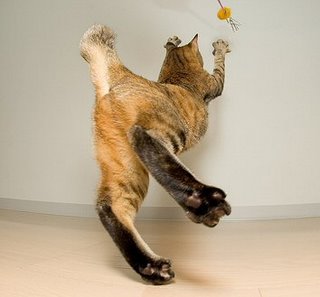
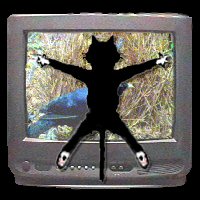
We watched a fascinating documentary on bower birds this weekend. Our cat, Maurice, found it fascinating, too. So fascinating, in fact, that he launched himself into a position like this: Behold, the might hunter Alas, I have no photograpic evidence of this event. As it was, we could barely keep our spleens in from laughing as he ricocheted to the floor. There is a chance we could reenact it, however. How much is the prize on America's Funniest Home Videos up to?
NB: Television, owners and feline have all recovered and are resting comfortably.

Thursday, March 16, 2006

Eleven, Twelve

I don't feel like being political today - too tired. So how about something nostalgic?

Here is a pretty darn cool remix of the Eleven Twelve song from Sesame Street. You can find the original version for six here, and more vintage Sesame Street and Electric Company stuff on YouTube, too.

Now if somebody would just buy me the Electric Company DVDs...

Wednesday, March 15, 2006

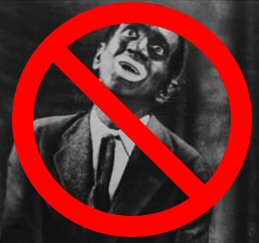
I Was Born A Poor Black Child

I have to admit I may be more sensitive to racial issues than your average honky. Strike that - I'm sure I'm more sensitive. I was raised in the seventies by extremely liberal parents, including a father who, as a neophyte minister in his first church, had Martin Luther King Jr. in to speak. I was one of only a very few white children in a largely black neighbourhood and city. But, most of all, I was partially raised in a half-black family by my black activist stepfather. This was a man who started educational programs to help disadvantaged black children, gave presentations on race issues and wore a dashiki nearly every day of his life - albeit dashikis that were sewn for him by my white mother. He made sure to teach me, his "mixed-race" children and anyone else he could about the difficulties and prejudices inherent in living with brown skin in the United States, and the insidious pressures of mainstream society on whites to accept and enforce our privileges. It was not an easy childhood, in many ways, and these were not easy lessons (my stepfather was never an easy man). But I am grateful for having had my eyes opened, at least somewhat, in a way most caucasians never have. It has not made me me comfortable about or an expert on race, but until we are all equal, who can be comfortable, and how much can anyone know?

So, it was with this perspective that I watched the premiere of Black. White. I can't remember where I first saw a commercial for this new show, but I do remember feeling both intrigued and nervous. The concept of a reality show wherein a white family is made up to look black and a black family is made up to look white is chock full of potential socio-political potholes. It could be easily be played cheaply for shock value and laughs, but it might just be fascinating.

NO I was just waiting for it to become cheesy or offensive. But it didn't. In fact, in it's premiere episode, Black. White. got just about everything right. They didn't choose stereotypical families to participate, but real, thoughtful people. They made them up convincingly enough that outsiders they interacted with seemed genuinely fooled (although I'm not sure how - they definitely look "off" somehow on camera, perhaps akin to burn victims who need to cover their wounds with prostheses and cosmetics). And most of all, they put them in situations where they could really learn, from discussion groups on race to country clubs, slam poetry classes to the kicker, living together in the same house. The cameras didn't shy away from uncomfortable moments, such as the black father, while in his white undercover role, being told by a white stranger that his neighbourhood was one of the last all-white middle-class bastions in L.A., and thus a safe place to raise his kids. But while the producers made the show thought-provoking, they didn't resort to too many cheap stunts like competitions or incendiary exercises or messages. So far, things has been kept as relatively "real" as they can in a show based on disguise.
Personally, my most pervasive emotion while watching this episode was a slightly nauseated embarrassment on behalf of all caucasians. While both families cast were clearly carefully picked as people who are fairly liberal and eager to participate, warts began to be exposed early on. Carmen, the white mother, displays an overly earnest idealization of black people that comes out most creepily in a seeming sexual fetishization of her husband when she first sees him in blackface. Meanwhile, Bruno, the white father, pig-headedly insists that black people too often assume racism where it doesn't exist and can't wait to be called racial epithets so he can "diffuse" them by not caring. (Even as a person who was deeply affected by what is ridiculously called called "reverse racism" as a child, I see that claiming black folks are too suspicious bespeaks a serious case of willful blindness.) Fortunately, Rose, the white daughter, seems to have a better head on her shoulders in terms of genuinely wanting to learn from the experience and respect all who are involved.

NO I am curious to see, however, if the black family finds their preconceptions changed whatsoever from the exercise. They know many white people are prejudiced, and what it is to have to "act white" to get along in life. This puts the parents, Brian and Renee, in the all-too-common role of educators and defenders of their own perspective that blacks often find themselves forced into in the presence of "progressive" whites. It's not lynching-variety racism, but it is is another burden, one that most minorities carry when faced with the juggernaut of the "average" American culture (read: privileged, male, heterosexual, Christian, caucasian). Meanwhile, the teenaged son, Nick, claims that, amongst his generation, racism is dead, which may point to evolving youth culture but, sadly, naiveté, as well. As a gay person, I am thrilled that more queer youths feel they can come out in high school, but that doesn't make me believe they won't face discrimination along the line. Unfortunately, I'd wager that his is the viewpoint most likely to be changed with experience.

So far, the jury is still out, but based on the premiere, Black. White. shows promise. Looking over the show site and myspace profile, I found that the producers, R.J. Culter (whose 30 Days with Morgan Spurlock is a logical precursor), Ice Cube and Matt Alvarez, put serious thought into how to create a show that was both meaningful and watchable. Something more than a reality show, but less than the documentary the creators want to be, it raises more questions than it answers, but still may not ask enough. I'll continue to watch, and judging from the reactions on their sites and some reviews, a wider audience will, too.

It's Going To Be A Bumpy Night

It's more than a wee bit disturbing when one arrives home to furniture knocked over, several areas strewn with large clumps of ripped-out fur and nary a one out of four cats in sight.

Update: Loaner kitty has been found with a bloody patch on his leg. That's it - everyone back to your corners. We'll open the doors when you deserve it.

Tuesday, March 14, 2006

No One Dies In This Post

At least I hope not, despite the NY Times noting it's now trendy to kill major characters off. That's in television shows, not blogging. Besides, I'm not sure I count as a major character, and this post is just another lesbian rant about The L Word.

That said - oy. The show has been stinking up the joint for some time now, and it seems they're interested in alienating as much of their audience as possible. Not that I disagree with killing off a major, well-liked character, in general, nor do I think it was terribly played in this show. Frankly, I think the final scene as Alice realized Dana's death was one of the best, most moving and real of the entire series (yes, even despite the previous episode's mortifying lightbulb-head baldy wig). But that's just the problem. The show has been so bad-it's-laughable-then-past-funny-to-grating, so melodramatic, so bizarre in it's structure this season, yet now they want to get serious? By killing off one of the more endearing characters and emotionally destroying the other for a second time?

Mrs. Nator and I have come to imagine Chaiken and her troupe as obtusely self-congratulatory. They must think they are being so clever with their quick-change characterizations and soap-opera "plot"lines punctuated by random after-school special/PSA-style soliloquies. But they're not. Most of the time, the show is just plain stupid. And the only reasons we watch are 1.) lesbian sex, even if it is often between frightening people or, even worse, not lesbian at all and 2.) as it's really the only queer chick drama out there we so want it to be worth watching. We're desperate, and, what's more, afraid to look away for fear of missing out on some important part of the dykely zeitgeist. I could stop watching Queer as Folk (the awful US version, not the fab UK one, of course) when it became truly unendurable because eventually I felt I wasn't obligated or motivated to participate in parsing it, somehow. With The L Word, I feel as though I'm supposed to have some investment in it, because it's all we lesbos have in the major media. I know that it's a dumb show about people I'd most likely never interact with (i.e., rich, skinny, self-centered L.A. residents), but I want it to be better, to be more. It might be different if we had at least a couple other dyke shows out there, and I know it can't be all things to all people, but we don't and... well, I'm not even sure the creators have any idea that who might be watching, at all.

Alas, in killing off Dana it seems they've gone both forward and back. They have an opportunity to use this to advance some real emotion and drama, but considering the variety-hour see-saw of narrative styles they've got going within even single episodes, it's unlikely. Instead, everybody the audience even vaguely likes is put through interminable crap or completely re-imagineered beyond recognition, and who wants to stick through that?

Meanwhile, in other storylines, as I think I've mentioned before, it's come to the point where I can't remember the difference between what's happened with Bette and Tina versus the farkuckt lesbians who used to be on QAF. I find myself literally asking Mrs. Nator things like "what happened to the ugly painter? Didn't Tina sleep with him?" "No, honey," she has to explain, "that was the stupid privileged LA lesbian who just had a baby and now wants to sleep with men on the other show. This stupid privileged LA lesbian who just had a baby and now wants to sleep with men is seeing the ugly non-painter."

Oh.

Once again, I'm sure I'll continue to watch, mainly because Mrs. Nator makes me. And, for some strange reason, I do seem to feel glimmers of hope now and then, in a funny line or particularly well-acted scene. I just keep wanting, beyond reason, to like the program, and feeling disappointed or even purposefully goaded. I suppose I should just keep a sense of humour about it, like they've done over at Fake Gay News. But I'm just too aggravated. Sigh.

At least Leisha Hailey's cute.

Monday, March 13, 2006

Of Mice and (Scary-Ass) Men

Most New Yorkers are revolted at the sight of large rodents.

I've been in a nasty mood lately. The combination of hating my job, endless health problems, working out but gaining weight, steroid shots and never getting enough time to do the things I want to do have been bringing me down and making me angry. I knew it was a danger sign when, after watching the well-done but extremely disturbing prisoner rape episode of Battlestar Galactica, I found myself unable to sleep and downloading Iron Maiden songs. The evil, oppressive, imperialist, abusive white men are coming to get us all! Run To The Hills, indeed. (Also, evidently I have regressed to the age of 13. I mean... Iron Maiden?)

I was in a foul fettle during my incredibly-delayed-as-usual commute this morning, reading about the continuing malevolence of the Bush administration in The New Yorker and listening to heavy metal (it really is the music of Satan!). I nearly yelled at the Screaming Preacher Lady who regularly touts Jesus as a remedy for hellfire in a West Indian accent at Atlantic Avenue, but we all know that rarely comes to any satisfactory end, so I just fumed. Finally arriving at my stop after multiple delays, I geared up into the disgruntled worker race-walk of Monday mornings towards my office. And that's when she appeared.

One of these things is not like the others

Incongruously, before Alice Tully Hall stood an animal mascot-costumed version of Maisy the mouse, super cute star of toddlers' books and television cartoons. Maisy looked happy but a little confused, teamed up with a giant rabbit I did not recognize and a woman in a suit, who seemed to be prepping them for whatever event that had not yet started. I can't explain why my heart lifted as I saw this group - it was just a couple of underpaid day labourers in fuzzy suits, no doubt - but they were damn cute, and just so random and silly. As I passed by, Maisy's gaze seem to follow me as she reached up and suddenly squeezed her nose at me as if it were a bulb horn. Why? I don't know, but a giggle bubbled up and I grinned. Maybe Maisy saw my sour puss and knew I needed a smile. Maybe a frustrated actor was adjusting his sagging headpiece. Whatever reason, it's the little things that get us through, sometimes. So thanks, Maisy, for the lift.